The errors-in-variables problem occurs when an explanatory variable is measured with error. If we measure an explanatory variable with error, then it is correlated with the error term, and the least squares estimator is inconsistent.
5.1.1 Example: Study Time and Test Scores
Suppose that test scores (\(y_i\)) depend on true study time (\(x_i^*\)):
\[
y_i = \beta_1 + \beta_2 x_i^* + v_i
\]
We measure test scores precisely, but we don’t observe true study time. Instead, we only have data on office hours attendance (\(x_i\)), which is a noisy proxy for total study time. Some students study a lot but never come to office hours; others show up frequently but don’t study much otherwise.
We model this measurement error as:
\[
x_i = x_i^* + u_i
\]
where \(u_i\) is the measurement error with mean 0 and variance \(\sigma_u^2\). Assume \(u_i\) is independent of the regression error \(v_i\).
5.2 Why Measurement Error Causes Endogeneity
When we substitute \(x_i^* = x_i - u_i\) into the true model:
where \(\lambda = \frac{\sigma_{x^*}^2}{\sigma_{x^*}^2 + \sigma_u^2}\) is called the reliability ratio (always between 0 and 1).
If \(\sigma_u^2 = 0\) (no measurement error): \(\lambda = 1\) and \(b_2 \to \beta_2\) ✓
If \(\sigma_u^2 \to \infty\) (pure noise): \(\lambda \to 0\) and \(b_2 \to 0\)
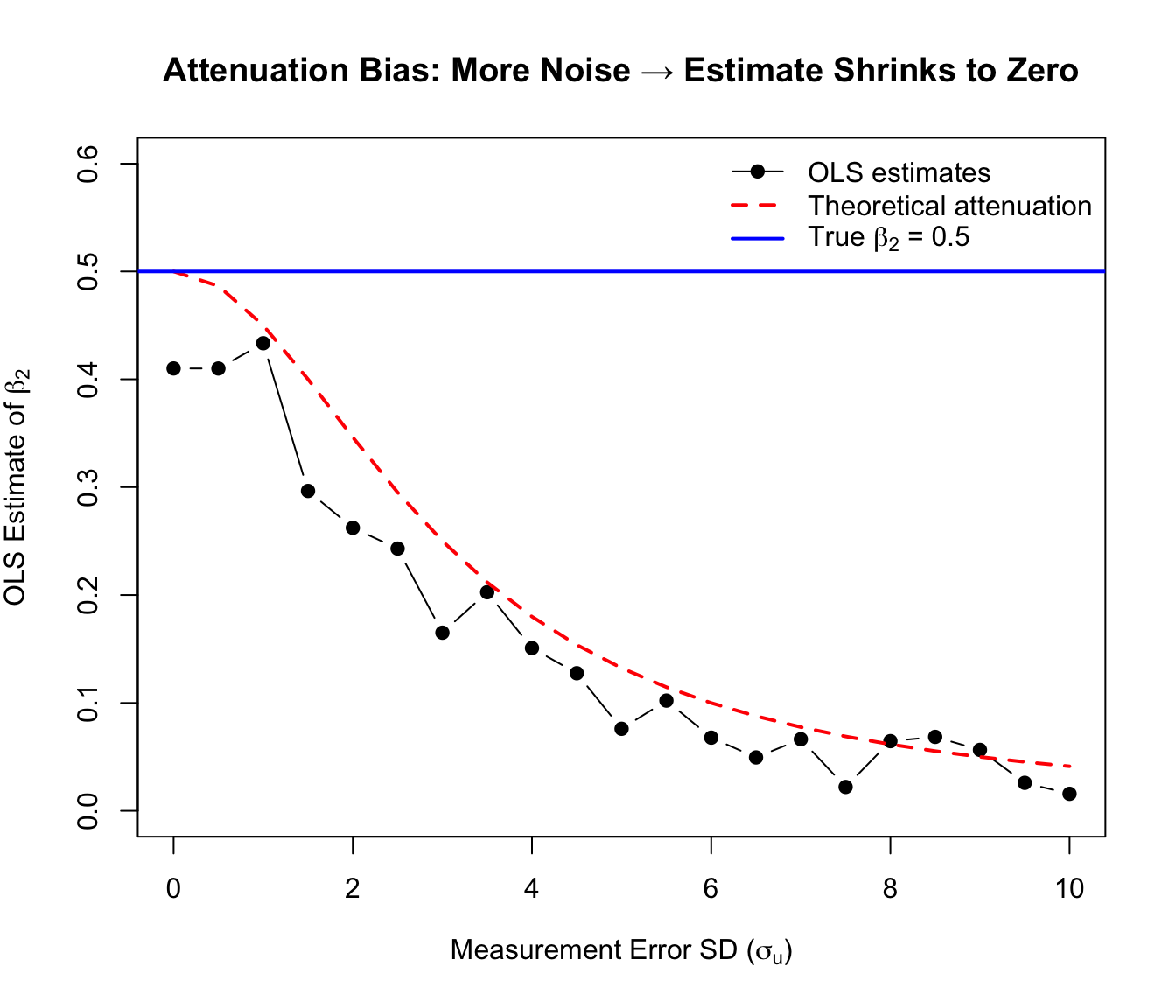
This is called attenuation bias-measurement error biases the coefficient toward zero, and more data won’t fix it.
5.4 Simulation: Watching Attenuation Bias in Action
Show code
set.seed(123)n <-500beta_true <-0.5# True study time (unobserved)x_star <-rnorm(n, mean =10, sd =3)# Test scoresy <-50+ beta_true * x_star +rnorm(n, sd =5)# Vary measurement error variancesigma_u_values <-seq(0, 10, by =0.5)estimates <-numeric(length(sigma_u_values))for (i inseq_along(sigma_u_values)) { sigma_u <- sigma_u_values[i]# Observed proxy (office hours attendance) = true study time + noise x_observed <- x_star +rnorm(n, sd = sigma_u) estimates[i] <-coef(lm(y ~ x_observed))[2]}# Theoretical attenuationsigma_x_star <-3lambda <- sigma_x_star^2/ (sigma_x_star^2+ sigma_u_values^2)theoretical <- beta_true * lambda# Plotplot(sigma_u_values, estimates, type ="b", pch =19,xlab =expression(paste("Measurement Error SD (", sigma[u], ")")),ylab =expression(paste("OLS Estimate of ", beta[2])),ylim =c(0, 0.6),main ="Attenuation Bias: More Noise → Estimate Shrinks to Zero")lines(sigma_u_values, theoretical, col ="red", lwd =2, lty =2)abline(h = beta_true, col ="blue", lwd =2)legend("topright",legend =c("OLS estimates", "Theoretical attenuation",expression(paste("True ", beta[2], " = 0.5"))),pch =c(19, NA, NA), lty =c(1, 2, 1), lwd =c(1, 2, 2),col =c("black", "red", "blue"), bty ="n")
As measurement error increases, the OLS estimate shrinks toward zero
WarningThe Intuition
When office hours attendance is mostly noise (high \(\sigma_u^2\)), it tells us almost nothing about true study time. If the regressor contains no real information, it can’t predict test scores-so the estimated coefficient collapses to zero.
TipWhat’s next?
When a regressor is endogenous (whether from OVB, measurement error, or simultaneity), Instrumental Variables provide a way to recover causal estimates. For panel data approaches to endogeneity, see Fixed Effects.